

AFTER THE MIST, WHAT THE WATER REMEMBERS
3-8 June
Sun Xiaolan
Curated by:
Ziyan Xu
D Contemporary in collaboration with Whiteshepherd Gallery are pleased to announce After the Mist: What the Water Remembers (岚散之后,水还记得), a solo exhibition by Hangzhou-based artist Sun Xiaolan, curated by Ziyan Xu. The exhibition opens on 3 June 2026 and runs through 8 June, with a Private View on 3 June from 3:00 to 5:00 PM. It is open to the public from 3 to 5 June (11:00 AM – 5:00 PM daily) and available by appointment from 6 to 8 June.
After the Mist: What the Water Remembers is Sun Xiaolan's first solo exhibition in London and her second major European presentation, following her acclaimed show Parler au vent, Parler à la montagne at Galerie Francis Barlier, Paris, in February 2026, attended by the President of the Société des Artistes Français. Gaoliang, Corresponding Member of the Institut de France, described her work as "a cup of the finest tea, drawing one into its depth."
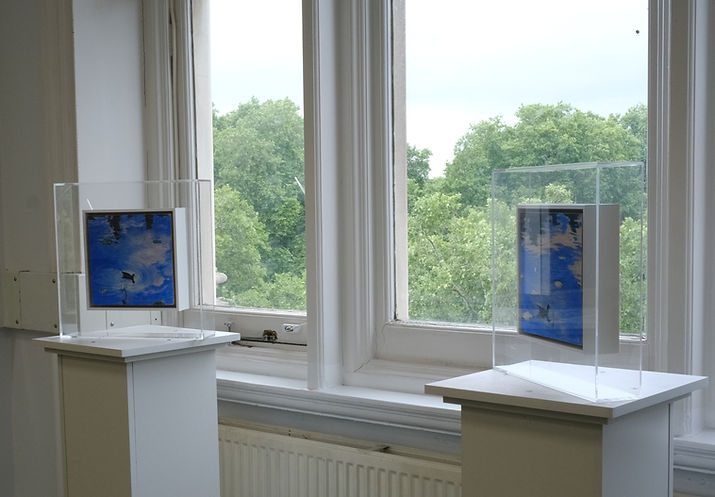
Twenty oil paintings on canvas and panel, spanning 2023 to 2026, gather here as a single long looking. The shimmer of West Lake at dawn; a market at Tianmuli alive with the warmth of ordinary life; a honey-coloured pond glowing in its own silence; two wild ducks drifting across still water, slowing the whole world down. Works range from the monumental Spring Water Rising (春水生, 140×140 cm) to intimate twenty-by-twenty centimetre panel paintings — every work an act of sustained attention, a return to a familiar place rendered with the patience of someone who has learned to wait for light.
Sun Xiaolan lives and works in Hangzhou. Her paintings live in the condition of flow. Rooted in the contemplative tradition of Chinese landscape philosophy and working in the language of contemporary European oil painting, she makes of paint itself a container for feeling. In her work, light is the shape of time; water is the mirror of memory. Her surfaces are organised around diffusion and overflow — light spreading across water, reflections exceeding their origins, edges dissolving into air at the moment of touch. Luce Irigaray observed that Western thought has long privileged form and boundary, while fluidity, overflow, and multiplicity — those things that exceed any outline — constitute a deeper and more elusive mode of being. Sun Xiaolan’s paintings give this fluidity visible form: the more intently you look, the more the surface opens, like water widening at every edge, always in the act of becoming.
The title turns on the character at the heart of the artist’s own name — 岚 (lán), mountain mist, that breath of vapour that rises at dawn and is gone by morning. After the mist lifts, the water still holds what passed through it: the quality of the light, the weight of a cloud’s reflection, the particular stillness of a moment before the world woke up. Gaston Bachelard, writing in Water and Dreams (1942), proposed that water is the element of material imagination: the substance through which we dream, feel, and remember before language arrives to name what we are experiencing. Sun Xiaolan’s paint dwells in exactly this way — carrying feeling quietly before speech, preserving time the way a lake holds light: openly, already, before any word arrives. This is an exhibition about an interior landscape — the luminous surface inside each of us that catches light, holds colour, and quietly remembers.
The exhibition is curated by Ziyan Xu, whose practice focuses on Gender Identity, Migration & Diaspora, and Feminist Body Politics. Xu situates Sun Xiaolan's paintings within a contemporary feminist philosophical framework, drawing on Luce Irigaray's theory of fluid mechanics — the idea that Western thought has long privileged form and boundary over fluidity and multiplicity — and Gaston Bachelard's phenomenology of water as the element of material imagination: the substance through which we feel and remember before language arrives. These frameworks are not imposed upon the work; they are drawn out by it.
INSTALLATION VIEWS
Ziyan Xu
Ziyan Xu is a curator, gallerist, and the founder of Whiteshepherd Gallery. Having grown up painting and trained formally in fine art, she later pursued an MA in Curating and Collections at University of the Arts London — a transition that sharpened her understanding of what it means to move between the world of making and the world of framing: how context shapes meaning, and how institutional structures determine whose work is seen, and where. It is this dual literacy — as someone who has inhabited both sides — that defines her curatorial perspective.
Rooted in her own experience as someone who belongs fully to neither China nor London, her practice is built around the artists who occupy similar in-between spaces: cross-cultural practitioners, particularly those from Asia, navigating diaspora, displacement, and the negotiation of identity across borders. Over five years, she has developed an independent curatorial model that gives these artists professional infrastructure at the earliest stages of their careers — a contribution that addresses a structural gap within the UK's contemporary art ecology, where such support for international emerging artists remains scarce.
She resists being called a cultural bridge — a bridge, she argues, is passive, implying equal passage where none exists. She speaks instead of "effective friction": the deliberate refusal to smooth over the real asymmetries of power, language, and market that shape how art moves between cultures. Alongside her work in London, she continues as long-term curator at XIMA Gallery in Hangzhou, enabling sustained exchange between British and Chinese contemporary art communities. In the post-Brexit landscape, where international cultural relationships require active, independent stewardship, her practice offers a working model for what meaningful cross-cultural contribution looks like — not as institutional gesture, but as daily curatorial labour.
THE EXHIBITION IS A COLLABORATION WITH :

Whiteshepherd is a London-based nomadic gallery and curatorial platform, founded on the belief that the most urgent conversations in contemporary art happen at the edges — between cultures, between languages, between structures of power that rarely acknowledge one another. We began in a century-old townhouse in South Kensington, and have since expanded across multiple venues in London. This mobility is not incidental. It reflects a curatorial position: that art, particularly art made by those navigating diaspora, displacement, and cross-cultural identity, cannot be contained within a single room.
We work with emerging artists whose practices resist easy categorisation — artists who push back against inherited structures of gender, cultural representation, and institutional authority. In practice, this means working with rising artists from the earliest stages: building their first exhibition concepts, developing sustainable commercial frameworks, and creating the conditions for their work to be seen and understood across cultural contexts. Through established partnerships with artists in London, we bring work into dialogue with Chinese audiences via exhibitions, residencies, and art fairs — in close collaboration with XIMA Gallery, which operates three spaces in China. Together, we do not seek to build a bridge between East and West — a bridge implies symmetry that does not exist. We seek instead to create the conditions for effective friction: moments where different aesthetic frameworks, viewing habits, and critical languages meet without being prematurely resolved.
We believe that cross-cultural exchange is not a gesture of goodwill. It is a practice that requires sustained attention to power, context, and the specific histories that artists carry with them. We work within the structures of the art market with open eyes, refusing to let those structures determine what is deserving of showing, or who is entitled to seeing.